2026 credit card surcharge laws by state
Check whether your state allows, caps, or bans credit card surcharges. Every answer is verified against the current statutes.
As of July 2026, credit card surcharges are banned in 3 states and legal with caps or conditions in 10 more. The remaining 37 states have no surcharge law, leaving card-network rules as the only limit. Debit surcharges are prohibited everywhere by card-network rules, and by state law in Texas and Maine, and in Louisiana starting August 1, 2026.
States that ban credit card surcharges
Surcharging is banned in 3 states, but cash discounts and dual pricing remain legal.
Bans surcharges on any payment method, including debit cards and digital wallets.
Discounts for paying by cash, check, or debit stay legal with clear, posted notice.
Violations are unfair trade practices (CUTPA), plus up to $500 per violation from the Department of Consumer Protection.
Conn. Gen. Stat. § 42-133ff
Bans surcharges on both credit and debit cards.
Cash discounts and dual pricing stay legal when the regular price is displayed.
Enforced by the Bureau of Consumer Credit Protection, which takes consumer complaints directly.
Me. Rev. Stat. tit. 9-A, § 8-509
Bans surcharges on credit cards. Debit is untouched by state law, though network rules still prohibit it.
Discounts for paying by cash or check are expressly protected by the same statute.
Enforceable by the Attorney General and through private lawsuits under Chapter 93A.
Mass. Gen. Laws ch. 140D, § 28AStates that allow, but restrict surcharges
10 states cap surcharges at 2-5% and require specific disclosures about surcharges.
| State | Surcharge caps | Requirements |
|---|---|---|
| California | No cap | Keep the fee avoidable and disclosed; card-only sellers must build it into advertised prices. B2B exempt. SB 478 |
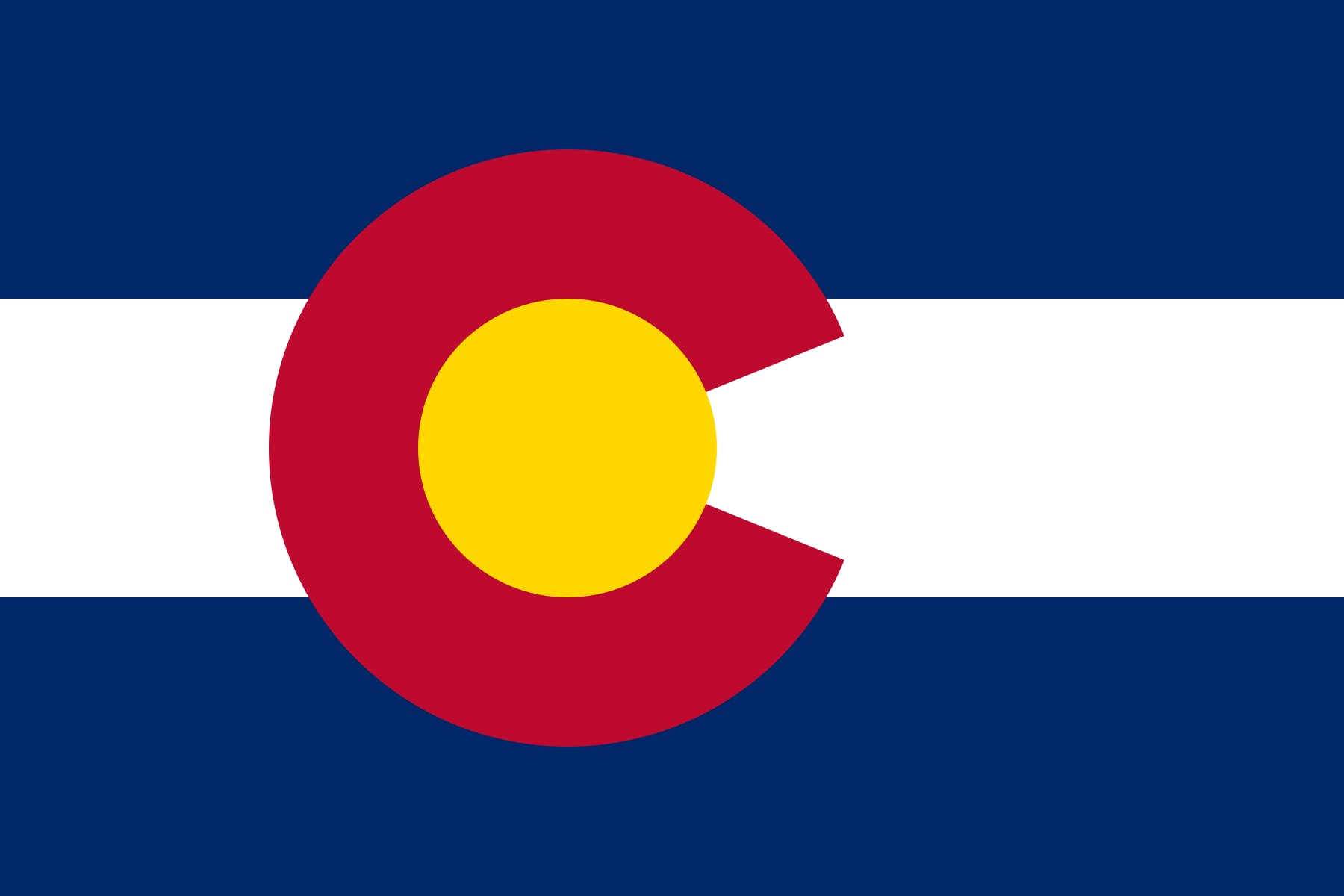
| Colorado | 2% or at cost | Post the exact statutory notice wording; itemize the surcharge on the receipt. § 5-2-212 |
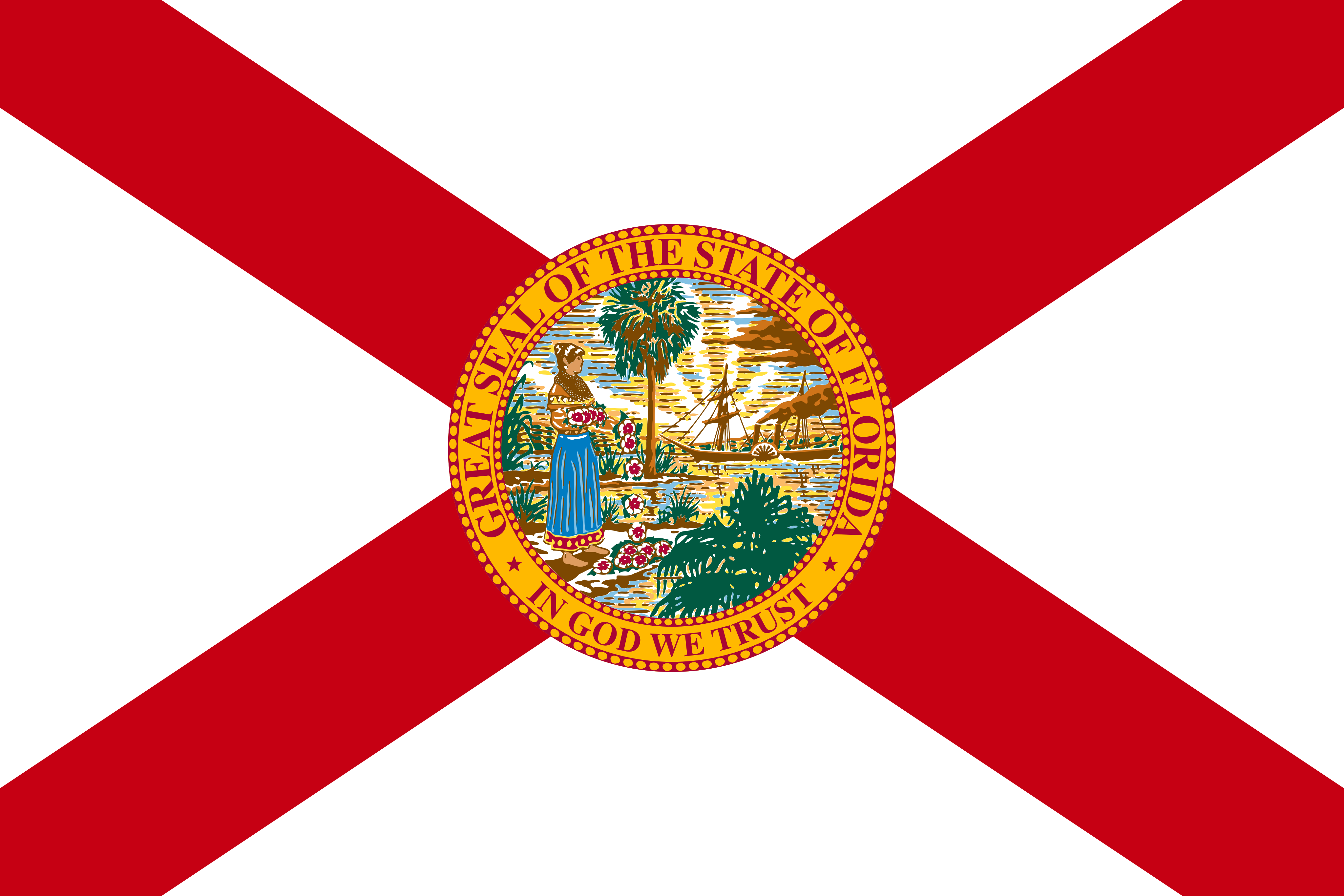
| Florida | No cap | Effectively legal; restaurants must disclose on menus, bills, and receipts since July 2026. § 501.0117; Dana's Railroad Supply (2015) |
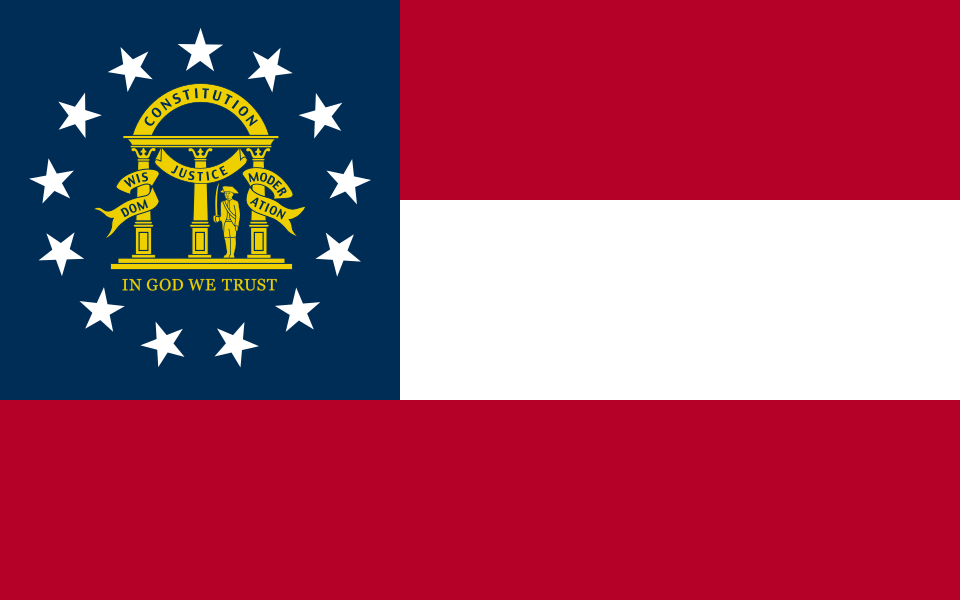
| Georgia | At cost | Offer a fee-free payment option; disclose the amount and that it is nonrefundable. § 13-1-15 |
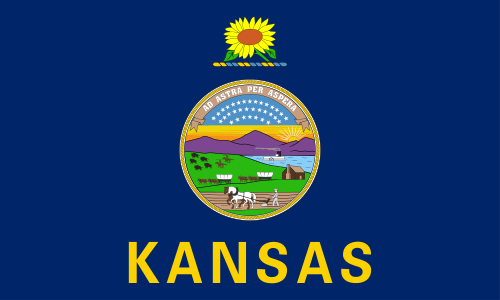
| Kansas | No cap | Clear, conspicuous notice of the amount at entry or point of sale, in advance. § 16a-2-403 |
| Minnesota | 5% | Disclose per channel; never surcharge your own store card. § 325G.051 |
| New Jersey | At cost | Disclose the amount before charging; a percentage is fine. N.J.S.A. 56:8-156.1 to 156.2 |
| New York | At cost | Post the full dollars-and-cents credit price; percentage-only signs are illegal. GBL § 518 |
| Oklahoma | Lesser of 2% or cost | Post the amount at entry and point of sale; credit can't be your only payment method. 14A § 2-211 |
| Texas | At cost | Ban on the books but unenforced; disclose clearly and never surcharge debit. § 604A.0021; Rowell v. Paxton (2018) |


States with no surcharge laws
37 states have no surcharge laws. Card network rules still apply, capping surcharge amounts and requiring additional registration and disclosures.
- Alabama
- Alaska
- Arizona
- Arkansas
- Delaware
- Hawaii3
- Idaho
- Illinois
- Indiana
- Iowa
- Kentucky3
- Louisiana2
- Maryland
- Michigan
- Mississippi3
- Missouri
- Montana3
- Nebraska
- Nevada
- New Hampshire
- New Mexico
- North Carolina1
- North Dakota
- Ohio1
- Oregon
- Pennsylvania1
- Rhode Island3
- South Carolina3
- South Dakota
- Tennessee
- Utah3
- Vermont
- Virginia
- Washington
- West Virginia
- Wisconsin
- Wyoming



- A bill is pending that would add a cap or disclosure rules.
- State law bans debit-card surcharges starting August 1, 2026. Credit surcharging is unaffected.
- Often misreported as capped or banned. Those claims trace to bills that never passed or a ban that expired in 2014.
Pass on card fees compliantly with Nickel
Send invoices with Nickel. Customers can pay with free ACH or card. Nickel handles the fees compliantly and you keep every dollar.
1. Send an invoice
Create an invoice or sync it from your accounting system. Send it securely through Nickel in one click.
2. Your customer picks how to pay
Nickel applies a 2.9% platform fee if they pay by card or $0 for ACH.
3. You keep the full amount
You receive the full invoice amount deposited right to your bank account.
How Nickel handles fees compliantly
Surcharge laws govern sellers who mark up their invoices with card fees. Invoices sent on Nickel are never marked up. A platform fee, not a card fee, is applied at checkout and handled for sellers end to end. Compliant in all 50 states and with all major card networks.
Your invoice is never marked up
Surcharging means marking up your invoice with a card fee. When you send an invoice on Nickel, the invoice and its subtotal never change. A fee is applied only at checkout.
Platform fee, not card fee
When customers pay by card, Nickel applies a platform fee at checkout. It is Nickel's fee for payment services, not your markup. If customers pay with ACH, it's free for you and them.
You never handle the fee
Surcharge laws apply when sellers charge their customers a card fee. Nickel handles the fee end to end, not you, and deposits the full invoice amount directly to your account.
Proven model, not gray area
This model is an established practice used by many eCommerce and payment platforms. More than 25,000 businesses already save $15M+ a year on credit card fees on Nickel.
FAQs
Is it legal to charge customers a credit card fee?
In most states, yes. An added fee for paying by credit card is called a surcharge, and that is what the laws regulate. Connecticut, Maine, and Massachusetts ban surcharges entirely. 10 more states cap them or add their own rules. The rest have no surcharge law at all. Wherever surcharges are legal, card network rules still apply. The fee must stay at or under your processing cost, never above Visa's 3% cap, and your customer must see it before paying. On Nickel, none of this lands on you. The fee your customer sees is Nickel's platform fee, not your surcharge.
Is it legal to charge a 3% credit card fee?
Usually, but not everywhere. Visa caps surcharges at 3%, so that is the practical ceiling wherever surcharging is legal. Your fee also has to stay at or under your actual processing cost. Oklahoma caps surcharges at 2%, so 3% is never legal there. Colorado also caps them at 2% unless your actual cost is higher. A 3% fee is illegal in the 3 states that ban surcharging. New York allows it but requires posting the full credit card price in dollars and cents, not a percent sign. And no percentage is ever legal on debit cards.
Can you charge a fee on debit card payments?
No, not as a surcharge. Card network rules ban debit and prepaid surcharges in all 50 states, even where credit surcharges are legal. Running a debit card as credit does not change that. Texas and Maine also ban it by state law. Louisiana's ban takes effect August 1, 2026. Nickel's platform fee is not a surcharge, so it works the same on credit and debit cards.
What's the difference between a surcharge, a convenience fee, and a cash discount?
A surcharge is an extra fee added to a credit card payment to cover processing costs. It is only allowed on credit cards, the state laws on this page apply to it, and card networks cap it at your actual cost. A convenience fee is a flat dollar amount, never a percentage, for paying through a channel you do not normally use, like paying by card over the phone when you normally accept checks in the mail. A cash discount works in reverse. You post one price and charge less when customers pay cash. True cash discounts are legal everywhere.
Watch out for cash discount programs sold by some processors. Many post the cash price and then add a fee at the register for cards. The networks treat that as a surcharge no matter what the processor calls it.
How does Nickel's platform fee work?
Nickel charges a 2.9% platform fee on every card transaction. It's not a surcharge, doesn't mark up your invoice, and is compliant with every state and card network. You choose who pays Nickel's platform fee. When you pass it on to customers, it gets applied at checkout and is disclosed transparently and compliantly.
Do surcharge laws apply to me if I use Nickel?
No. Nickel charges a platform fee for its payment service. It's not a surcharge and doesn't mark up your invoice. So surcharge laws and network surcharge rules do not apply to you. There is nothing to register, no notices to send, and nothing to configure state by state. Nickel discloses the fee on every payment before your customer confirms, and they can always switch to free ACH.
Stop eating card fees today.
See your ROI and savings using our calculator
Savings calculator →See a demo. See how Nickel can improve your cashflow in 30 minutes.
Talk to our experts →