Hawaii Credit Card Surcharge Laws
Hawaii credit card surcharge laws for 2026 — what's legal, merchant disclosure rules, restaurant + online compliance, and alternatives.
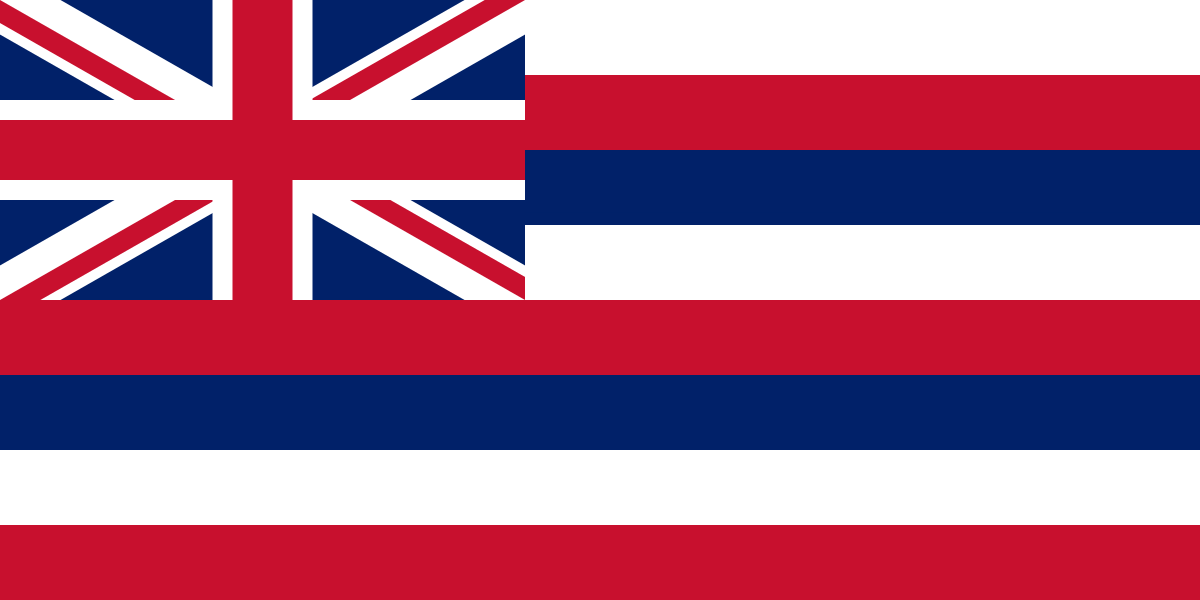
Hawaii has no state law restricting credit card surcharges, though repeated legislative attempts to ban the practice have created confusion. While Nickel helps businesses navigate payment processing efficiently, understanding the rules that actually govern surcharging in Hawaii helps B2B companies and accounting professionals make informed decisions about their payment strategies.
Lawmakers have tried more than once to limit when businesses can add fees for credit card payments — bills in 2013, 2014, and 2022 all failed — so the rules that apply today come from the card networks, not the state.
Legal Disclaimer: This information is for reference only and does not constitute legal advice. Consult with an attorney before implementing any surcharge programs, as rules and enforcement can change.
Is Credit Card Surcharging Legal in Hawaii?
Credit card surcharging is legal in Hawaii. No state statute bans or restricts surcharges. The "in lieu of payment by cash, check, or similar means" language you may see quoted comes from bills that never passed — SB 470 (2013), SB 2745 (2014), and HB 1233 (2022) all died in the legislature.
With no state statute in play, card-network rules are what govern surcharging in Hawaii. Before adding a surcharge, notify the card networks and your acquirer, apply the fee to credit cards only, keep it at or below your actual cost of acceptance (no more than 3% for Visa), and disclose it clearly before the customer pays.
Hawaii's position matches most of the country. Only Connecticut, Maine, and Massachusetts still ban surcharging, and the National Conference of State Legislatures lists Hawaii as having no state surcharge statute.
What's allowed in Hawaii
Hawaii businesses can use any of these strategies to manage card acceptance costs:
- Cash discount programs - Offer lower prices for customers paying with cash, check, or other non-credit payment methods
- Multi-tiered pricing - Display different prices for various payment methods, with the card price disclosed as clearly as the cash price
- Convenience fees for alternative channels - Flat fees for payments made through a non-standard channel, such as by phone or online, where card-network rules permit them
- Credit card surcharges - Add a fee to credit card transactions, following the card networks' notice, cap, and disclosure requirements
What's not allowed in Hawaii
Card-network rules, not state law, prohibit these practices:
- Debit card surcharges - Network rules limit surcharging to credit cards, so debit and prepaid transactions can't carry a surcharge
- Hidden fees - Any undisclosed charges that appear during the payment process
- Surcharges above the caps - Fees that exceed your actual cost of acceptance or the network ceilings, including Visa's 3% cap
- Unregistered surcharge programs - Adding surcharges without first giving the required 30-day notice to your processor (plus Mastercard's web-form notice)
Penalties for non-compliance in Hawaii
With no state surcharge statute, accountability for Hawaii businesses comes through other channels:
- Consumer complaints about deceptive or undisclosed fees can still be filed with the Hawaii Department of Commerce and Consumer Affairs Office of Consumer Protection
- Card-network enforcement runs through your acquiring bank, which can fine merchants or suspend card acceptance for rule violations
- Industry oversight through existing merchant agreement compliance requirements
- Federal oversight continues to apply for businesses operating across state lines
Consumers who encounter undisclosed or deceptive fees can file complaints by calling (808) 586-2653 or through the online complaint system.