The Problem
Four tools, four different headaches
Running a conference means collecting large payments from a lot of different people at once. Exhibitors buying booth space. Sponsors signing on for activations. Partners paying for speaking packages. Each one is a meaningful invoice, and every one of them has to clear before the doors open.
For years, collecting that money meant maintaining a patchwork of payment tools at Biohackers World, and every tool in the patchwork broke in its own way.
The team started on QuickBooks, which offered payments without fees during an initial trial window. Once that window closed, the fees arrived: a percentage on every card payment and a flat charge on every ACH transfer. For a business collecting booth and sponsorship invoices at volume, that added up quickly enough to send Mick Safron, the company’s founder and CEO, looking elsewhere.
Melio came next, and it worked well enough at first. Biohackers World signed on when the company was only a few months old. But over time payments started failing for reasons that were difficult to explain to a customer. An authorization checkbox at the end of the flow was optional, so many payers skipped it and the transaction quietly died. Others tried to pay a business invoice with a personal card and were blocked. Each failure meant restarting the process, and after enough of them, the bank began flagging the payments too.
PayPal created a different problem. Because PayPal doesn’t allow the processing fee to be passed to the payer, every PayPal payment meant working backward with an online fee calculator to figure out how much extra to add to an invoice so the correct amount would actually land. Zelle wasn’t a fix either, since booth and sponsorship invoices routinely exceeded its per-transaction limits, forcing the team to split one payment across several transfers or abandon the method entirely.
Before Nickel, every payment method created a different operational issue.
Mick Safron, Founder & CEO
The real cost wasn’t the fees alone. Explaining gross-ups to sponsors, restarting failed payments, and splitting transfers around a transaction limit pulled time from three separate teams and created friction with the exhibitors the whole process was meant to serve. What Mick wanted was simpler than any of the tools were delivering: a way to give a vendor a clear choice, either pay by bank transfer with no fee to anyone, or pay by card and cover the fee, exactly as Biohackers World’s agreements had always said.
The Solution
One link, full amount
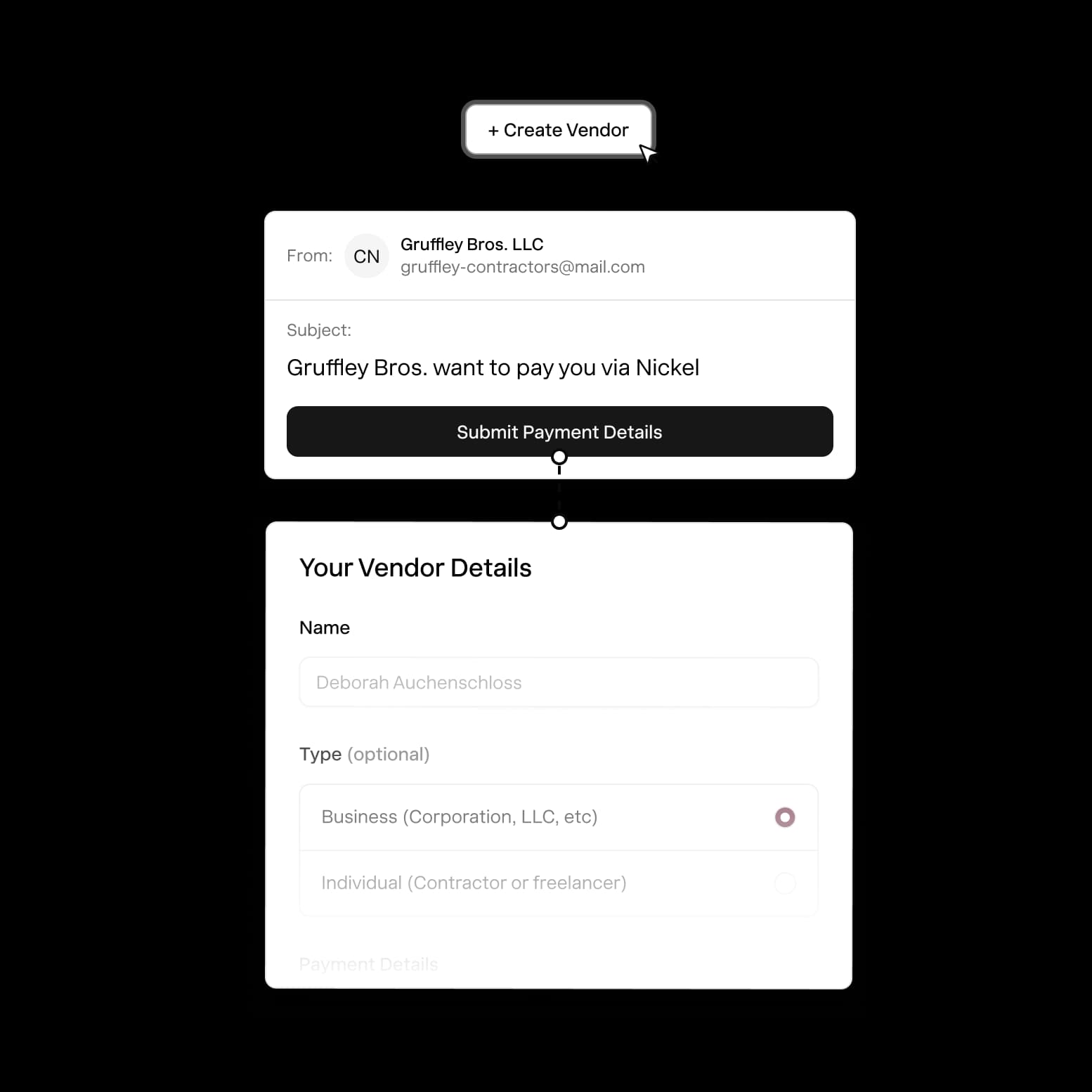
Biohackers World moved exhibitor and sponsorship payments to Nickel and made it the default option on every invoice. The workflow is now consistent from end to end. The partnerships team sends out the agreement. Once it’s signed, the invoice goes out with a Nickel payment link attached, and the exhibitor pays through that link. Nothing else is required from either side.
Our default option is Nickel because it’s easiest for us. We just send them a link and we don’t pay any fees.
Mick Safron, Founder & CEO
The most immediate difference was in what stopped happening. No fee calculators. No split transfers to work around a limit. No re-running a payment because an authorization box went unchecked.
We send the exhibitor a payment link, they complete the payment, and we receive the full invoiced amount without paying a processing fee. We no longer have to explain fee gross-ups, split larger payments into multiple transactions, or spend time troubleshooting failed authorizations.
Mick Safron, Founder & CEO
The part that mattered most to Mick was what Nickel let him offer the people paying him. Exhibitors can pay by ACH with no fee on either side, or pay by card and cover the processing fee themselves. That choice had been written into Biohackers World’s agreements all along, and Nickel was the first platform that let the team honor it as written instead of absorbing the cost or quietly building it into an invoice. For a sponsor writing a large check, the distinction is not small. Most exhibitors, Mick says, appreciate having a direct bank-payment option that doesn’t require adding a card fee to a booth or sponsorship payment, and on larger transactions that can represent a significant saving.
Introducing any new payment method to vendors can be its own hurdle. In practice it hasn’t been one here. Exhibitors open the link, enter their business and bank details, and complete the payment without anyone walking them through it. There has been no meaningful resistance from vendors, and a clean payment link reads better to a sponsor than a request to send several Zelle transfers because of a limit.
The change showed up internally as well. The old patchwork hadn’t only cost money, it had cost coordination, pulling finance, sales, and exhibitor success into every failed payment and every fee explanation.
It reduced the amount of back-and-forth between our finance, sales, and exhibitor-success teams. Payments became easier to initiate, easier to track, and much less stressful for everyone involved.
Mick Safron, Founder & CEO
Asked what he’d tell another conference or expo organizer weighing a payment platform, Mick starts with a reframe: the percentage on the invoice isn’t the real cost.
I would tell them to look at more than just the percentage charged by a payment processor. They should also calculate how much staff time is being spent explaining fees, following up on failed payments, dealing with transaction limits, and reconciling multiple payment platforms.
Mick Safron, Founder & CEO
Conference organizers, he points out, regularly collect large payments for booths, sponsorships, activations, and speaking packages, and paying a percentage on every one of them becomes a major expense fast. His recommendation is a practical one: test it with a few exhibitor or sponsorship payments and compare the experience against whatever you’re using now. For Biohackers World, it quickly became the default.