

Our take: When a small business's DSO creeps up, the cause often sits further up the chain. Large companies are paying their suppliers later, so the best defense is an invoice that's quick to pay and hard to forget.
Why it matters: 59% of small business owners have invoices 30 or more days overdue, up from 47% a year earlier. 39% say one late payment made it hard to cover payroll or bills in the past year.
The short answer: Days sales outstanding (DSO) is the average number of days it takes you to collect payment after a sale on credit. It's getting worse. North America's 1,000 largest companies took 2.1 more days to collect in 2025, the third straight year of decline, and they made up for it by paying their own suppliers later.
Ask a small business owner why cash is tight and most will point to a customer who's late. That's where the problem gets noticed. It usually starts somewhere quieter, with large companies that have learned to hold on to their cash a little longer each year.
DSO puts a number on that wait. It measures how long your money sits in unpaid invoices and a lower number means you collect faster. US small businesses wait 29.7 days on average to get paid and the payment lands 8.6 days late, according to Xero Small Business Insights.
It doesn't have to take that long. We looked at more than 130,000 invoices paid through Nickel: half were paid within 3 days of the invoice date and 88% within 30.
We think your DSO is worth working out every month. One that rises a few days at a time is easy to miss until payroll week.
How to calculate DSO
The DSO formula is (accounts receivable ÷ credit sales) × number of days. Use the same period for both numbers: 30 days for a month, 90 for a quarter, 365 for a year. Count credit sales only, since a sale paid upfront never becomes a receivable.
For example, a distributor ends the quarter with $120,000 in unpaid invoices on $360,000 of credit sales. Its DSO is ($120,000 ÷ $360,000) × 90 = 30 days. On net 30 terms, that means customers pay on time on average.
The number means the most next to your payment terms. A DSO of 45 on net 30 terms means customers pay about 15 days late on average.
What a good DSO looks like
A good DSO is close to your payment terms. If you bill on net 30, a DSO near 30 means customers are paying on time. Here's what businesses are seeing now.
| Source | Who it covers | What it found |
|---|---|---|
| Xero Small Business Insights | US small businesses, September quarter 2026 | 29.7 days to get paid on average and 8.6 days late. Texas averaged 36.8 days and Florida 24.0 |
| QuickBooks 2026 Late Payments Report | US small business owners | 59% have invoices 30 or more days overdue, up from 47% a year earlier |
| Atradius 2026 payment practices survey | B2B suppliers in the US, Canada and Mexico | 7 in 10 were paid late and late payments touched 23% of their B2B receivables |
| The Hackett Group 2026 Working Capital Survey | North America's 1,000 largest public companies | DSO rose 2.1 days, the third year in a row, and got worse in 40 of 50 industries |
Each source counts a little differently, so compare yourself with the one closest to your business.
Why DSO is rising
Large companies had a strong 2025. The Hackett Group's 2026 Working Capital Survey of North America's 1,000 largest public companies found revenue up 6% and operating cash flow at a 13-year high. Their receivables grew 11%, nearly twice as fast as revenue, so more of that revenue sat in unpaid invoices.
They kept their cash cycle flat another way. Days payable outstanding, the time they take to pay their own bills, improved by 2.9 days to its best level since 2021. In plain terms, their customers paid them later and they paid their suppliers later. From the inside, that looks like good cash management. From the supplier's side, it means waiting longer for the same invoice.
That wait lands on suppliers. If you sell to larger companies, their slower payments show up as your higher DSO. Payment terms are moving the same way. Where North American suppliers changed their terms recently, the change was more often to longer terms, Atradius found. It happened most among trade companies and in the US and Mexico.
Smaller companies feel it first. In a CoreData survey for Fortis, Avalara and Traild of 100 finance leaders at companies with up to $100 million in revenue, slow invoice-to-cash and high DSO was the most common working-capital problem, named by 61%. The gap doesn't need to be big to hurt. 39% of small business owners say one late payment made it hard to cover payroll or bills in the past year, QuickBooks reports.
How to lower your DSO
You can't set when a large customer pays, but you control most of what happens between the invoice and the deposit. None of these steps is complicated. What matters is doing them on every invoice, not only the big ones. We covered more ideas in how to get clients to pay faster.
Ask for payment sooner
Terms set the pace. Among businesses on net 30 terms, 55% have overdue invoices, compared with 26% of those that ask for payment right away, according to QuickBooks. Shorten terms where you can. On long jobs, bill in stages: Nickel's milestone payments on the Plus plan let you collect part of an invoice as work gets done.
Make paying the easy part
Every invoice should carry a link the customer can pay from in a minute. A customer who has to call for wire details or find a checkbook has one more reason to wait. Nickel sends branded payment links on every plan and customers can pay by bank transfer or card. ACH is free on every plan and cards are 2.9% flat, with you choosing whether you or your customer pays the fee.
Put repeat invoices on autopay
For customers you bill every month, recurring invoices and autopay take the wait out entirely. The customer saves a card or bank account on file, sets a limit and an end date, and Nickel charges it when the invoice is due. Both come with the Plus plan, at $35 a month billed annually or $45 billed monthly.
Follow up on every invoice
Reminders work only if they go out. Nickel sends payment reminders on every plan and the Plus plan sends them automatically on a schedule. Aging reports on Plus show which customers are falling behind before it shows up in your DSO.
Get the money as soon as it's paid
DSO stops counting when the customer pays, but you can't use the cash until it lands. 49% of small business owners say standard processing times create cash-flow gaps, QuickBooks found. With Nickel Banking, ACH payments land in 1 business day instead of 2 or 3 and card payments arrive instantly. There's no extra fee and the cash earns 2% APY while it sits there.
Let Penny chase overdue invoices
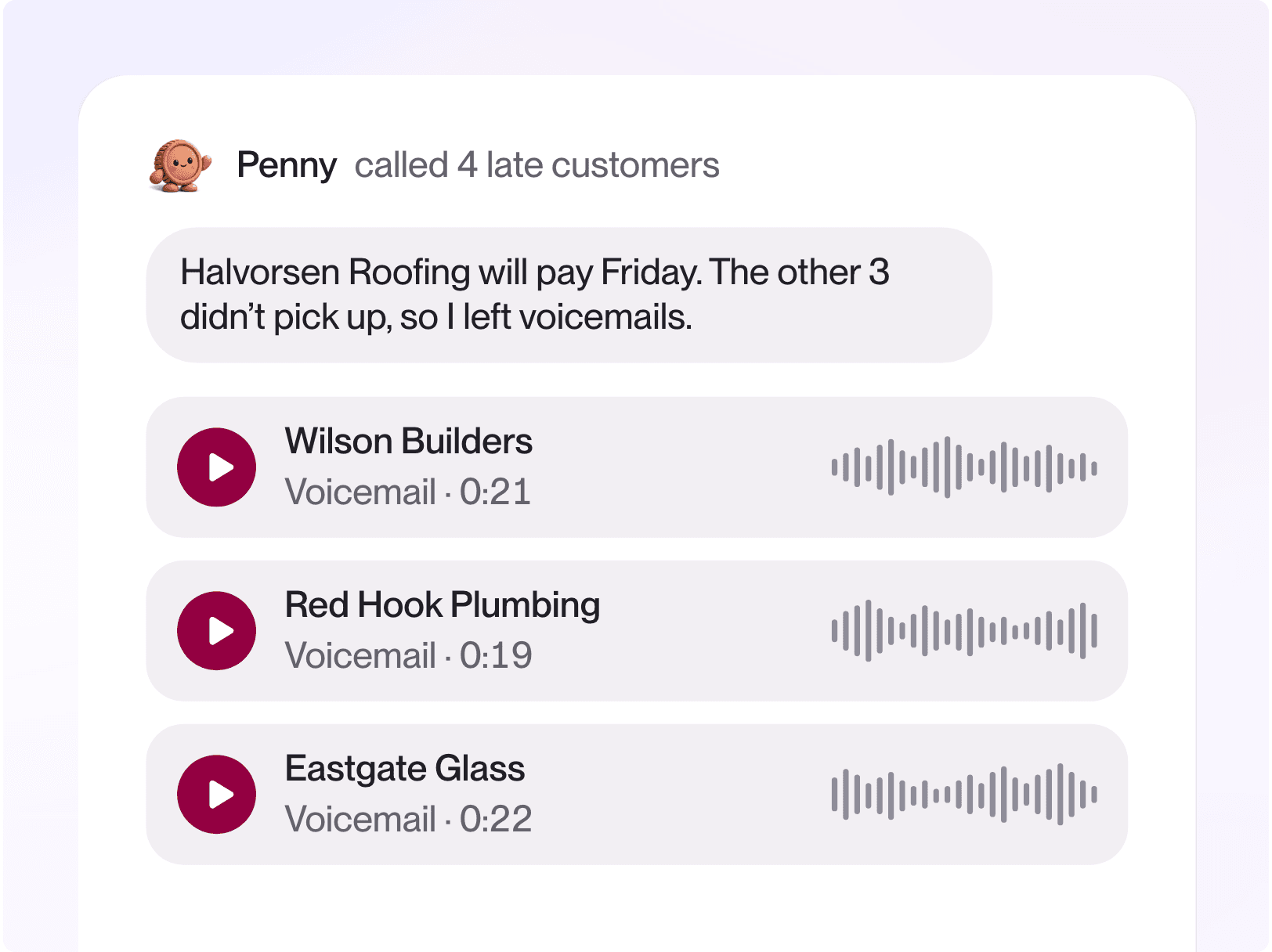
Follow-up is the task that slips first, because it's nobody's favorite job. Penny, Nickel's AI teammate, can take it off your list. Copy her on the email to a customer who owes you and tell her what you need. If the invoice is still unpaid, she can call the customer about it and leave a voicemail when no one picks up.
For the follow-ups you'd otherwise forget, set up a routine once. Ask Penny to check for overdue invoices every Monday and follow up on each one. She'll keep at it every week.
She works within the same permissions you have and tells customers they're dealing with an AI. She can't make a customer pay sooner, but she makes sure no invoice goes quiet. If you'd like to see Penny work on your own invoices, our team can walk you through it.
FAQs
Is days sales outstanding the same as AR days?
Yes. Days sales outstanding, accounts receivable days and days in receivables all name the same measure: the average number of days between a credit sale and the payment for it.
What is a good DSO?
A good DSO is close to your payment terms. On net 30 terms, a DSO near 30 means customers pay on time. US small businesses wait 29.7 days on average to get paid, according to Xero.
Is a high or low DSO better?
Lower is better. A low DSO means cash comes in soon after you make a sale. A high or rising DSO means more of your money is tied up in unpaid invoices.
What does a DSO of 45 mean?
It means customers take 45 days on average to pay after a sale. On net 30 terms, that's about 15 days late.
How long can accounts receivable be outstanding?
As long as your terms allow, but the longer an invoice sits, the harder it gets to collect. 59% of small businesses have invoices 30 or more days overdue, QuickBooks reports.
Does DSO include cash sales?
No. Count only sales made on credit terms. A sale paid upfront never becomes a receivable, so including it makes your DSO look better than it is.
Your DSO starts with the next invoice
A rising DSO rarely looks dramatic from the inside. It looks like one customer paying a week late, then another, until payroll week comes around. Large companies are taking longer to pay and that wait lands on the businesses that supply them. Shorter terms, easy payment links, autopay and steady follow-up are what bring it back down.
This week, run the formula on last quarter and compare it to your terms. If it's well above them, start with your oldest unpaid invoices.
For more on terms and cash flow, read what net 30 payment terms mean, how to solve cash flow problems and why accounts receivable is negative on the cash flow statement.


